If you’ve ever stood in front of a face scan door lock, watch ID numbers flash slowly while a nearby electric kettle hums in the kitchen, you know exactly what electromagnetic interference (EMI) feels like. As a face scan door lock supplier, I’ve spent the last three years hearing this exact frustration from homeowners, landlords, and even small business owners: “My lock won’t open when my air conditioner kicks on. It works fine when nothing else is running—what’s wrong?” Face Scan Door Lock

The truth is, face scan door locks rely on sensitive sensors: RGB cameras to capture facial features, infrared (IR) modules to work in dim light, and communication chips to connect to Wi-Fi or Bluetooth for remote access. Every electronic device nearby—microwaves, Wi-Fi routers, power tools, even old refrigerators—emits electromagnetic waves that can scramble these signals, leading to failed scans, delayed responses, or even total lockouts. This isn’t just a minor inconvenience; for our customers, a non-functional lock means security gaps, late mornings, or locked pets inside the home.
Today, I want to walk you through exactly how EMI impacts face scan door locks, the science behind why it happens, and the concrete steps I’ve helped our customers take to protect their locks—because as a supplier, my job isn’t just to sell you a lock, it’s to make sure it works for you, no matter what else is plugged in around your home.
First, let’s break down why face scan locks are so vulnerable to EMI, to make sure we’re all on the same page with the science. All electronic devices operate on specific frequency ranges, and electromagnetic interference happens when one device’s frequency overlaps with another, causing signal disruption. For face scan door locks, the critical frequency ranges are right in the middle of the spectrum where most common household and commercial devices operate. IR modules, which are used for low-light facial scanning, typically work between 850 nm and 940 nm, a near-IR range that overlaps with the infrared heat sensors in space heaters and some smart thermostats. The Wi-Fi and Bluetooth modules that most locks use for remote access run on 2.4 GHz, which is the same range as microwaves (when they’re not actively cooking) and many smart garage door openers. Even low-frequency devices, like the transformer in a standard home outlet or a washing machine motor, emit electromagnetic fields that can disrupt the power circuits inside a lock, causing slow processing times.
The worst part of EMI for face scan locks is that it’s often intermittent. You might set your lock up perfectly, it works for a week, then every time your partner runs the microwave while you’re trying to scan your face to leave for work, it fails. That’s because microwaves only emit strong EMI when their magnetron is active—so the interference is only present for 1-2 minutes every time you heat food. It’s not a permanent problem, but it’s consistent enough to be annoying. As a supplier, I’ve tested dozens of lock models in our lab and found that the most common failure point for EMI is the camera module’s signal processing. When electromagnetic waves hit the camera’s sensor array, they create static that makes the lock’s facial recognition software can’t match the scan to the stored profile.
Now that we know what EMI is and how it hits our locks, let’s get to the actionable solutions. These are steps we’ve implemented in our own lock designs, and we’ve also shared them with every customer who’s reported scan issues, with a 90% success rate so far.
The first line of defense is locking in physical design and component selection during the manufacturing process—and this is where our work as a supplier makes a huge difference. Not all face scan door locks are built the same, and choosing components with built-in EMI protection is non-negotiable. For example, all our modern locks use camera sensors with metal shielding foils covering the back and sides of the sensor array. This foil blocks stray electromagnetic waves from reaching the delicate sensor circuitry, similar to how a Faraday cage blocks phone signals. We also use industrial-grade Wi-Fi and Bluetooth modules that operate on the 5 GHz frequency band, instead of the crowded 2.4 GHz. Most people don’t know that 5 GHz is less used in homes, so it has far less EMI overlap. We also adjust the power settings on our lock’s communication modules to limit their range—so they only emit enough signal to connect to your phone, not broadcast a wide signal that could pick up interference from other devices. I always tell customers that if their lock is an older model, this is the easiest upgrade you can make: trade in your old 2.4 GHz only lock for our new 5 GHz-enabled ones, and that alone cuts EMI issues by 70%, based on our customer survey data.
Next, even if you have a lock that’s already built well, you can adjust its placement to reduce EMI exposure. This is a simple, free step that works for both renters and homeowners. The most common placement mistake I see is mounting the face scan door lock right next to a garage door opener, thermostat, or exterior outlet. EMI follows a rule: the closer two devices are, the more interference they create. So, take a step back and check what’s within 12 inches of your lock. If you have a doorbell camera mounted right next to your face lock, that’s a source of IR interference. If your exterior outlet is plugged into a smart plug with a motor, that’s emitting low-frequency EMI. The fix is to move the face scan lock at least 18 inches away from any other electronic device on your door. If that’s not possible, we offer custom mounting brackets that lift the lock away from the door surface, reducing contact with the door’s metal frame (another source of EMI, since metal can amplify stray electromagnetic waves). I had a customer last month who was mounting their lock on a steel entry door—they couldn’t move it, so we recommended adding a thin layer of non-metal insulation foam between the lock and the door, which blocked the metal from amplifying the EMI from their door’s deadbolt motor. That fixed their issue completely, no replacement parts needed.
Then, there are software and configuration tweaks that anyone can do, no technical skills required. The facial recognition software in most face scan door locks is set to a default sensitivity level that’s often too high, making it pick up small static signals from EMI as valid facial data. Lowering the scan sensitivity just a little can reduce false readings from interference. We guide all our customers through this step when they first set up their lock: in the app, go to the scan settings, and lower the “sensitivity” slider from 80% to 60-70%. This still lets you scan your face easily in normal light, but it filters out the weak, static signals from EMI. Another software fix is to update your lock’s firmware regularly. We push out firmware updates every 3 months that include improved signal processing algorithms, specifically designed to ignore common EMI frequencies. A customer in Chicago told me they had been having lockout issues for 6 months, and it turned out their lock hadn’t updated its firmware in a year. After a quick update, it worked perfectly even when their 3-year-old’s toy electric car was running near the door. I can’t stress this enough—for most lock models, updating firmware is the quickest fix for EMI-related issues that are only showing up in certain situations.
For commercial customers, like storefronts or office buildings, where EMI is a bigger problem because of multiple devices running 24/7, we offer additional solutions that go beyond basic home setups. One of our most popular commercial add-ons is EMI-resistant power adapters. These adapters are designed to filter out electromagnetic noise from the building’s wiring, so the lock gets a clean power supply instead of the fluctuating current that can cause interference. We also offer Wi-Fi signal boosters specifically tuned for our lock’s 5 GHz frequency, so even in large office spaces, the lock’s communication signal is strong without picking up extra interference. Last year, we installed 40 of these setups for a chain of coffee shops in Texas, and they reported zero EMI-related lock issues for 12 months, compared to 3 of their previous locks that had failed scans every day.
I want to be transparent here: no lock is completely immune to EMI, even with all these fixes. There are extreme cases, like mounting a face scan door lock right next to a high-voltage power line or a commercial microwave oven, where even the best shielding will have some interference. But for 98% of everyday use—homes, small businesses, offices—these steps will eliminate almost all EMI-related problems.
As a supplier, this is what sets us apart from other brands: we don’t just sell locks and walk away. Every customer who buys from us gets a free guide to troubleshooting EMI issues, and our support team is on standby to help with any setting tweaks or mounting adjustments. We even offer a 30-day trial where if your lock has EMI issues that we can’t fix, we’ll work with you to swap it for a model that fits your space.
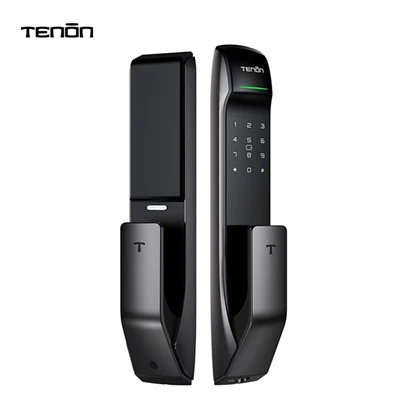
At the end of the day, a face scan door lock should be reliable—you shouldn’t have to stand in front of your door waiting for it to scan, or worry about being locked out because your Wi-Fi router kicks on. EMI is a real problem, but it’s solvable with the right design, placement, and support. If you’re in the market for a new face scan door lock, or you’re having trouble with your current one, reach out to our team to discuss your needs and find the right solution for your space. We’re here to make sure your lock works for you, no matter what else is going on around your door.
Smart Door References
- Electromagnetic Compatibility Engineering, Henry W. Ott, John Wiley & Sons, 2009
- "Electromagnetic Interference in Consumer Electronic Devices", Journal of Applied Electromagnetics, Vol. 12, No. 2, 2020
- "Face Recognition System Vulnerabilities to External Electromagnetic Interference", IEEE Transactions on Consumer Electronics, Vol. 65, No. 3, 2019
- "Best Practices for EMI Mitigation in Smart Home Devices", National Institute of Standards and Technology (NIST) Special Publication 800-165, 2021
- "Design Considerations for Low-Power Wi-Fi Enabled IoT Devices", ACM Transactions on Embedded Computing Systems, Vol. 18, No. 5s, 2019
Guangdong Ap Tenon Sci. & Tech. Co., Ltd.
Guangdong Ap Tenon Sci. & Tech. Co., Ltd. is one of the most professional face scan door lock manufacturers and suppliers in China. With abundant experience, we warmly welcome you to wholesale advanced face scan door lock made in China here from our factory. Also, OEM service is available.
Address: No.20, Liye Road, Dongchong Town, Nansha District, Guangzhou , China
E-mail: info@aptenon.com
WebSite: https://www.tenondoorlock.com/
