If you’re in the market for a new cooktop, chances are you’ve stumbled on a 5-burner gas hob and wondered if it’s even compatible with your home’s natural gas line. As a supplier of 5-burner gas hobs, I get this question at least a dozen times a week, and it’s not just a random curiosity—connecting the right appliance to your gas line can mean the difference between seamless cooking and a messy, dangerous headache. Let’s break this down, straight from the team that tests and ships these hobs every single day, so you don’t have to guess. 5 Burner Gas Hob
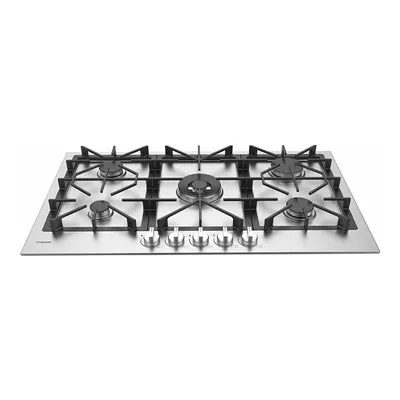
First, let’s get one thing out of the way: yes, you can connect a 5-burner gas hob to a natural gas line, but only if your line can handle the required gas pressure and volume. A lot of people mix up “possible” with “easy,” and that’s where problems start. I’ve seen customers show up with a brand-new 5-burner hob, try to hook it up to a 1/2-inch gas line that was sized for an old 2-burner hotplate, and end up with a flame that sputters or won’t light all burners. That’s not a defect in the hob—it’s a mismatch in the line.
So what do you actually need to check? Let’s start with gas pressure, because that’s non-negotiable. Most residential natural gas lines run at a pressure between 3.5 and 7 inches of water column (WC), and that’s exactly what our 5-burner hobs are designed for. Our hobs are tested at the factory to operate safely within that range; if your line is outside of it—say, below 3 WC or above 14 WC—you’ll need a pressure regulator installed by a licensed gas fitter. Trying to adjust the regulator yourself is a fire hazard, full stop. I’ve also had customers ask if they can convert a propane-only hob to natural gas to save money, and while that’s technically possible, it’s not something we recommend for DIYers. Our hobs are engineered with specific orifice sizes for natural gas, and modifying those orifices usually voids the warranty and can lead to inefficient gas use.
Next up, gas volume, which is measured in British Thermal Units per hour (BTU/hr). A standard 5-burner gas hob puts out between 40,000 and 70,000 BTU total, depending on the model. For context, a small 2-burner hotplate is usually around 20,000 BTU, so a 5-burner hob doubles or triples that demand. Your gas line needs to deliver enough volume to meet that demand without dropping pressure—no low pressure means weak flames, and too much of a demand drop means inconsistent cooking, like your large wok burner cutting out mid-stir-fry. The rule of thumb we tell customers is: if your gas line is 10 feet or less from the main natural gas line coming into your home, a 3/4-inch line is enough for most 5-burner hobs. If it’s more than 10 feet, you’ll need a 1-inch line to avoid pressure loss. A lot of older homes have 1/2-inch gas lines, and that’s the #1 cause of problems we hear about. I had a customer last month who had an old 1/2-inch line for his stove, and when he added a 5-burner hob, he could only run two burners at a time before the third wouldn’t light. He ended up having to upgrade his line, and once we connected it to a new 3/4-inch line, all five burners worked perfectly. That upgrade cost him a few hundred dollars, but it was way cheaper than dealing with a hob that wouldn’t work.
Then there’s the installation part, which is where most people go wrong. You can’t just hook a gas hob up with any old hose. Our hobs require a flexible gas connector that’s rated for natural gas and 3/8-inch or 1/2-inch diameter, depending on the model. Hard piping is also an option, but it needs to be done by a professional. Even if you’re handy, gas installation isn’t a DIY project. A small leak that you can’t smell (natural gas is odorized, but small leaks can go undetected) can lead to carbon monoxide buildup or a fire. We always recommend hiring a licensed, insured gas fitter to do the installation, and to make sure they check your line size and pressure before they start. That’s not just a suggestion—it’s the safest way to make sure your hob works the way it’s supposed to.
Now, let’s talk about common myths we hear from customers. One big one is that all 5-burner hobs are the same when it comes to gas needs. That’s not true. Some of our premium models have a single high-output burner (up to 15,000 BTU) for wok cooking, and others have balanced burners for everyday use. The total BTU can vary by 20,000, so you can’t just assume your line can handle any 5-burner hob. Another myth is that you can run a 5-burner hob on a propane line if you convert it. While some models are convertible, it’s not a simple swap. Converting usually requires new orifices, a new regulator, and sometimes adjustments to the burner jets. I’ve seen customers try to do this with a generic conversion kit, and more often than not, the flames are too high or too low, wasting gas and creating a safety risk. If you have a propane line and want a 5-burner hob, look for models that are explicitly designed for propane—they’re tested to meet those requirements, so you don’t have to do the work.
What if you’re not sure about your line? The best thing to do is call your local gas utility company. They can send a technician to test your line pressure and measure the volume it can deliver, usually for a small fee or even for free. That’s way cheaper than buying a hob and then realizing you have to redo your gas line. We also have a team of experts who can help you check the specifications of your home’s gas line against our 5-burner hobs—just reach out, and we’ll walk you through the steps. I always tell customers that it’s better to ask a few questions upfront than to deal with a problem after installation.
Once you’ve confirmed your line is compatible, installing a 5-burner gas hob is a game-changer for any home cook. You can sear a steak on one high-output burner, simmer a sauce on a low-heat burner for hours, and have three other burners going for sides all at once. We’ve had customers tell us that once they switched to a 5-burner hob, their weekly meal prep got so much easier, and they never go back to a smaller 2 or 3-burner model. The key is making sure the connection is safe and the line can keep up.

Now, if you’re ready to explore 5-burner gas hobs and talk through your specific line needs, our team is here to help. We can answer all your questions about line compatibility, installation requirements, and which of our models is right for your home. Don’t take chances with gas connections—let us guide you to a safe, seamless installation.
Under Cabinet Range Hood References:
- American Gas Association. (2022). Residential Natural Gas Line Sizing Standards. Retrieved from industry safety guidelines for gas appliances
- International Association of Plumbing and Mechanical Officials (IAPMO). (2021). Gas Appliance Installation Code Requirements.
- U.S. Consumer Product Safety Commission (CPSC). (2020). Safe Installation of Gas Cooking Appliances.
- Factory Mutual (FM) Global. (2021). Performance Standards for Gas Range Pressure and Volume.
Hangzhou DE&E Smart Home Co., Ltd.
As one of the most experienced 5 burner gas hob manufacturers and suppliers in China, we offer a wide range of products with superior quality. Please feel free to wholesale cheap 5 burner gas hob from our factory. Contact us for more details.
Address: No. 98 Hongxing Road, Xiaoshan District, Hangzhou City, Zhejiang Province 311231, China
E-mail: sabrina.liao@chinadee.com
WebSite: https://www.deeappliances.com/
